
Over the years, it has become ritualistic to use Hindu festivals for pushing the flawed idea of progressiveness, modernity, secularism, and feminism. This year, a jewellery brand advertisement for Raksha Bandhan, featuring actress Kriti Sanon, has sparked backlash online for her attire and the concept of the ad.
Revealing outfit of Kriti Sanon, missing traditional elements, and inclusion of a dog: GIVA Raksha Bandhan ad triggers outrage
In the recently released pet jewellery collection ad by GIVA centred on the Raksha Bandhan theme, actress Kriti Sanon is wearing an ivory or off-white bralette-style blouse with a cape and draped skirt while tying Rakhi to an on-screen brother and then to a dog described as family.
While Sanon’s ‘revealing’ outfit drew maximum criticism for being “inappropriate” for the Hindu festival celebrating sibling bond, social media users also criticised the absence of the key religious markers associated with the festival; the puja thali was present only as an insignificant prop. Many also deemed the inclusion of a dog as a mockery of the ritual.
The debate is turning to feminism and women's choices.. but it is not.
— amit kilhor (@amitkilhor) August 25, 2026
GiVa wanted to sell Dog's Rakhis and bracelets by showing bralette of Kriti sanon.
Nothing wrong with it per se. Sex sells.
And coz they wanted to sell Pet Rakhis, so they chose occasion of Rakshabandhan… pic.twitter.com/ppTclVwNDy
Kriti Sanon defends revealing outfit in Rakhi ad, Rahul Gandhi jumps in to support her
After the outrage over the GIVA Raksha Bandhan ad, Kriti Sanon published an expected defence via her Instagram Story, arguing that the essence of festivals lies not in the clothes one wears but in the emotions and meaning held for the traditions. Regarding outrage over her outfit in the ad, Sanon asked, “When will we stop telling women what to wear??”
“The essence of festivals is not in the clothes you wear; it is in the emotions and meaning you hold for the traditions. Rakshabandhan is a bond of protection. My sister and I tie rakhi to each other. We know we can protect each other no less than a brother would have. We pray for each other’s health, happiness & long life. And for us, this prayer and promise extends to our dogs too! Afterall, they are family!” she wrote.
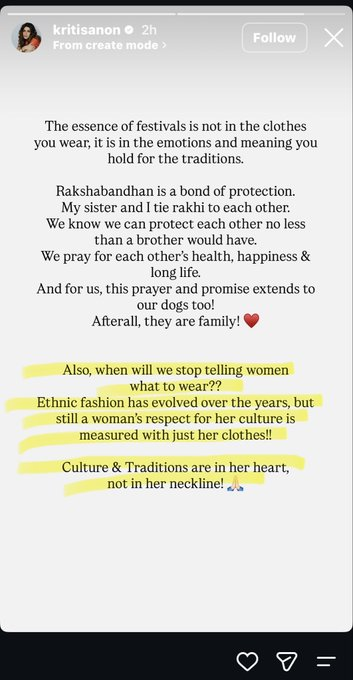
“Also, when will we stop telling women what to wear?? Ethnic fashion has evolved over the years, but still a woman’s respect for her culture is measured with just her clothes!! Culture & Traditions are in her heart, not in her neckline!” Sanon added.
Quite conveniently, Kriti Sanon turned the matter into a feminism issue, making it about women’s autonomy and agency; however, the issue was, in fact, about preserving the sanctity of a sacred Hindu festival.
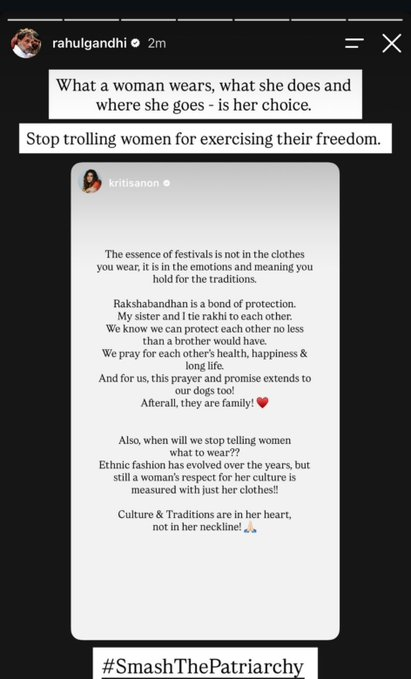
Meanwhile, Congress MP Rahul Gandhi jumped in to exploit the issue to gain traction and bolster his image as a ‘feminist hero’ amidst the controversial ‘Smash The Patriarchy’ campaign that selectively targets Hindus.
Gandhi wrote, “What a woman wears, what she does and where she goes – is her choice. Stop trolling women for exercising their freedom,” adding the hashtag #SmashThePatriarchy.
Kangana Ranaut slams GIVA jewellery ad over the outfit worn by Kriti Sanon
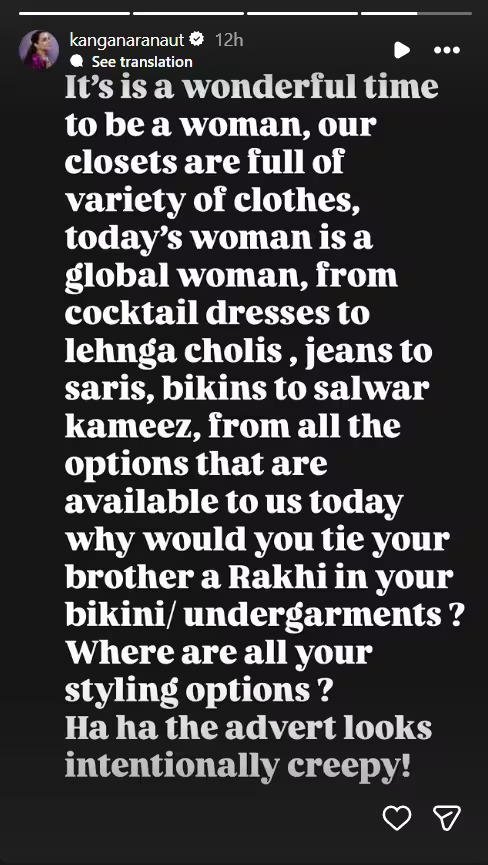
Actress and BJP MP Kangana Ranaut expressed sharp criticism against the Raksha Bandhan ad by GIVA jewellery featuring Kriti Sanon. While Ranaut was not opposed to Sanon’s outfit itself, she questioned, “Why would you tie your brother a Rakhi in your bikini?”
In an Instagram Story published on 25th August, Kangana Ranaut wrote, “It’s is a wonderful time to be a woman, our closets are full of variety of clothes, today’s woman is a global woman, from cocktail dresses to lehnga cholis, jeans to saris, bikins to salwar kameez, from all the options that are available to us today why would you tie your brother a Rakhi in your bikini/ undergarments? Where are all your styling options? Ha ha the advert looks intentionally creepy!
GIVA retracts controversial ad amidst outrage, makes it about dogs even as the primary issue was Kriti Sanon’s inappropriate attire
On 26th August (Wednesday), the jewellery brand GIVA announced that it had taken down its Raksha Bandhan ad with actress Kriti Sanon, a day after her attire drew harsh criticism on social media. The company withdrew the advertisement and stated that it did not want to “hurt the sentiments of some segments of society.”
“We have the highest regard and deep respect for Indian culture, traditions and festivals. As a brand, we have always believed in celebrating these joyous moments with the entire family and this time we wanted to extend the love and celebration to our pets. If our recent advertisement has inadvertently hurt the sentiments of some segments of society, that was not our intent at all. Out of respect, we have withdrawn the said advertisement from all media,” the company tried to defend itself in an official statement.
However, GIVA quite oversmartly made its statement about the controversial commercial’s concept of tying Rakhi to a dog, even as the main issue was Kriti Sanon’s outfit inappropriate for the occasion of Raksha Bandhan.
GIVA jewellery brand, perhaps, thought that they would lose ‘progressive’ points if they acknowledged that the primary outrage was about Sanon’s attire in the ad and not tying Rakhi to dogs.
The commercial’s retraction is essentially a damage control move designed in a way that the retraction would pacify those outraged, and also ensure that they will not have to address the issue of Sanon’s inappropriate attire, and appear ‘regressive’.
No, Kriti Sanon, outrage over neckline was not about suppressing a woman’s choice or agency; it was about the sanctity of Raksha Bandhan
Let it be made clear: no one has any objections to Kriti Sanon’s choice of wearing any attire. No one is even interested in telling her what clothes she should wear or should not in her personal life, as that is totally her prerogative. Sanon is a public figure and has worn diverse types of attire from suits and sarees to bikinis in her movies, but no one has ever raised questions.
Invoking personal choice and agency is wrong when the context is public commercialisation. The issue was solely about her outfit being inappropriate for the occasion of Raksha Bandhan, a sacred Hindu festival celebrating the sibling bond. The sexualisation of a sacred Hindu festival is intolerable. Context-based appropriateness matters.
Had the actor portraying her on-screen brother in the film been shown bare-chested, the public outrage would have been similar because the issue is not about gender but context and the sacredness of the festival.
The criticism was specifically about the occasion and representation. The commercial built around Raksha Bandhan used a bralette-style, plunging neckline blouse instead of traditional festive clothing, combined with tying Rakhi to a dog and skipping even the basic aarti and tilak rituals.
The outrage was not that women should not wear deep neckline outfits or that Kriti Sanon has no right as a woman to wear such outfits or any other outfit she likes. The criticism remained focused on this particular styling and concept in this specific advertisement explicitly invoking a sacred sibling-protection festival.
These high-sounding arguments that ‘clothes don’t define culture’ are factually incorrect. Attire is a crucial marker of cultures globally. You see a Lehenga-Choli, you know it’s Indian, specifically Hindu attire. You see a Burqa, you know it’s Muslim attire; you see a Kimono, you know it’s Japanese attire. Just as
The question was about how the makers of the ad film took the liberty to treat the sacred Hindu festival as a flexible fashion and lifestyle backdrop.
“The essence of festivals is not in the clothes you wear, it is in the emotions”, “a woman’s respect for her culture is measured with just her clothes”, “when will we stop telling women what to wear?” None of Kriti Sanon’s remarks grasps the crux of the issue.
Kriti Sanon gave the issue a rhetorically effective spin, making it about illegitimate and regressive policing of women’s bodies and choices. Perhaps Sanon knew that it would respond to the charge about sanctity and suitability with an argument about agency and evolution of ethnic fashion; one would either fail to argue in abstract terms or end up appearing regressive and patriarchal gatekeepers of religion and culture.
While Sanon initiated relocation of the conversation from the festival’s sanctity and her attire’s suitability to personal liberty and feminism, Rahul Gandhi completed it with his “what a woman wears…is her choice…Smash the Patriarchy” remarks. The debate soon shifted from the GIVA jewellery commercial diluting the essence and religiosity of Raksha Bandhan to ‘trolling women for their clothing choices’.
Hinduism, Hindu culture, festivals and their celebrations are very diverse. In many places, particularly North India, a Puja Thali for Raksha Bandhan comprises a Rakhi, Kumkum for Tilak, turmeric-mixed uncooked rice or Haldi-Akshat, Doob or Durva grass.
Since the GIVA commercial was shot in Hindi and in a North Indian setting, at least some of these, if not all, elements should have been incorporated in the ad, however, the makers were so invested in the concept of glorifying the concept of glorifying Rakhi to a dog and picking inappropriate attire for Kriti Sanon, that they omitted even the basic traditional elements associated with the festival.
The question also arises as to who has given the authority to the makers of ad films to misappropriate Hindu festivals and disrespect Hindu traditions to push their supposed ‘progressive’ agenda.
Why did GIVA not release its pet jewellery collection advertisement on Bakrid, with the message, “This Bakrid, don’t slaughter goats, gift them our jewellery”.
Kriti Sanon has visited Gurudwaras, wished Eid on social media pages, and in all such appearances, she wore occasion-appropriate dresses.
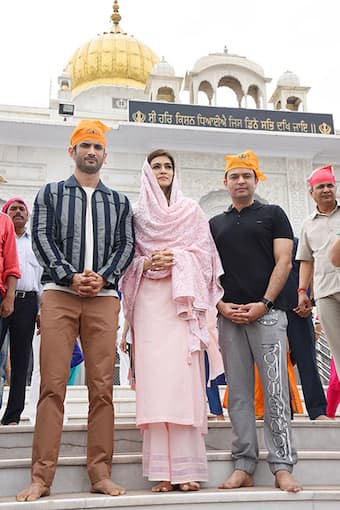
In June 2017, Kriti Sanon visited the Gurudwara Bangla Sahib in New Delhi. During her visit, she wore a light pink salwar suit and covered her head as per the tradition. Why did she not wear a revealing outfit and boast that ‘ethnic fashion has evolved’, ‘respect for Gurus is in the heart, not in the neckline!”
Social media users have highlighted Kriti Sanon’s past posts extending wishes on Eid, and other non-Hindu festivals wherein her attire appeared to a great extent, if not fully appropriate culturally.
There are also pictures and videos wherein Kriti Sanon is seen attending someone’s funeral or related prayer meet. Sanon chose to wear a traditional white dress. Why wear white attire, isn’t respect in heart and does not reflect in attire?
From GIVA ad to Manyavar’s Kanyamaan: Why are Hindu festivals and traditions an easy tool for ad creatives to push their liberal-progressive agenda?
Notably, this is not the first time that a commercial has misused Hindu traditions for pushing unrelated agendas at the cost of mocking the tradition itself. Back in September 2021, Clothing brand Manyavar received flak after its ad campaign painted Hindu rituals and customs as ‘regressive’. The advertisement featuring Alia Bhatt portrays ‘Kanyadaan’ as an oppressive practice and suggests ‘Kanyamaan’ as an alternative.
Manyavar claimed that it was “Promoting a progressive way of thinking, one tradition at a time!” Apparently, ‘Kanyamaan’ “gives a new spin to wedding rituals, highlighting the idea of respecting brides instead of ‘giving them away’.”
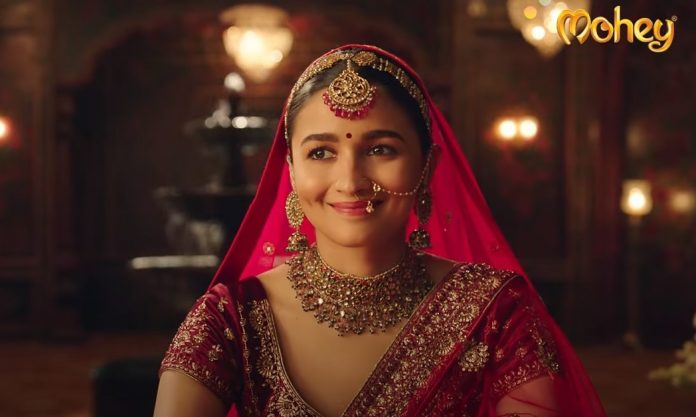
People had questioned back then why Manyavar did not make similar ‘progressive’ suggestions for Islamic Nikah ceremonies, which are essentially a form of contract marriages. It was also rightly asked that Hindu marriages accord maximum respect to women and yet they only get scrutinised through ‘Kanyamaan’ type propaganda, while Muslims continue to practice polygamy, and remain exempt from criticism or scrutiny of any kind.
In 2019, Hindustan Unilever received backlash over a Surf Excel Holi advertisement, showing a small Hindu girl making sure her neighbourhood kids are out of colour so that she could take her Muslim neighbour, also a kid of the same age, for namaz without fear of getting colour splashed at him.
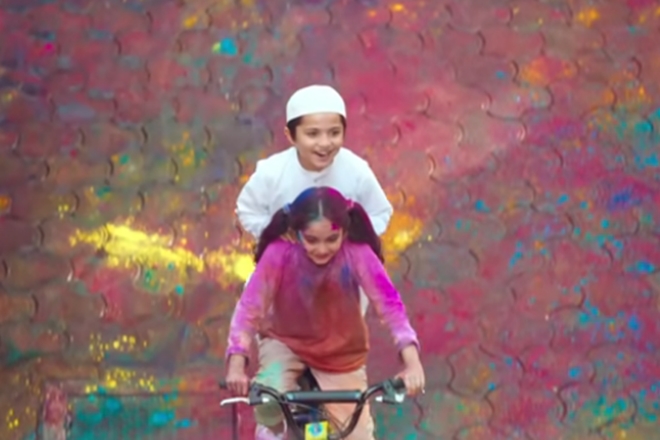
Before this, the FMCG conglomerate released another Hinduphobic ad reducing the Kumbh Mela to a place where people go to abandon their ageing parents.
In 2021, Fab India secularised, rather Islamised, the Hindu festival of Diwali by launching its Diwali collection with the name ‘Jashn-e-Riwaaz’. The brand made a reference to the ‘festival of love and light’ in one of their deleted tweets.
It needs to be seriously studied how and why Hindus, be it Bollywood actors, social media influencers or common Hindus, have conditioned themselves into associating modernity, progressiveness, secularism, inclusivity, and all sorts of activism with Hindu festivals, even at the cost of stripping them of their religious and cultural significance.
Why is it that these maximal liberties with reinterpretation of festivals, their meanings, and symbolism are taken only with Hindu festivals and traditions, while when it comes to Eid, Christmas, or any other non-Hindu festival, their religious and cultural significance is highlighted and sanctity is protected?
Apparently, the answer lies in knowing the extent of the outrage of the affected community. Hindu festivals, traditions, beliefs, even scriptures are subjected to public scrutiny, sometimes even to derogatory questioning and ridicule because it is known that the Hindu community would not react violently. Their outrage would either stay confined to social media, peaceful demonstrations or legal remedies.
The reason ad creatives, filmmakers, actors and politicians do not dare to execute even performative scrutiny of the traditions, beliefs, festivals, or scriptures of Muslims, Christians, or any other religious community, knowing that their outrage will not be limited to social media.
Muslims have a history of hitting the streets, running riots, giving open calls for Sar Tan Se Juda against those whom they perceived have ‘insulted’ their religion. None exemplifies this better than the 2022 Nupur Sharma episode. The ex-BJP spokesperson had only uttered the facts mentioned in the Islamic scriptures, and yet Muslims perceived it as an ‘insult’ and rioted across the country, burning Sharma’s effigy.
Once PETA India attempted to preach to Muslims kindness towards animals on Eid, they were assaulted, and since then, the body has reduced its advocacy against animal slaughter on Bakrid largely to social media.
Salman Rushdie was attacked by a Muslim man years after his book Satanic Verses was first published.
Even at present, the Congress party has opened a front against the Manusmriti, the Hindu scripture, calling it ‘anti-woman’, selectively highlighting its verses and misinterpreting them. However, the so-called ‘secular’ party did not dare to throw light on Quranic verses that declare women as less intelligent than women, or regressive verses from any other religious scriptures.
Why? Because they know that these communities are ‘minorities’ only in number, but are unparalleled when it comes to weaponising street veto.
From films, advertisements, to intellectual and political discourse, Hindu festivals, traditions, beliefs, and even Gods are subjected to scrutiny, criticism, and even mockery, because somehow the country which had been under Congress rule for a significant period of time, fostered a culture of criticising and ‘reforming’ everything Hindu to come across as liberal and progressive, protecting the sanctity of the religious traditions, symbols, and culture regardless of ‘minorities’ to uphold secularism, tolerance, and ‘idea of India’.
The Kriti Sanon-Raksha Bandhan ad episode is a disturbing continuation of exploiting Hindu traditions for peddling supposedly ‘progressive’ and ‘modern’ agendas by stripping the tradition or festival itself of its true religious and cultural essence. Once again, Hindus have been painted as ‘regressive’ for pushing back against misappropriation and distortion of their festival, while those behind this violation are being hailed as progressive feminists braving ‘patriarchy’.
The silver lining, however, is that the Hindu community has stopped bothering about what Islamo-leftists label them for protecting the sanctity of their festivals and traditions. Hindus no longer allow unchecked turning of their festivals into blank canvases for ‘progressive’ advertising.