

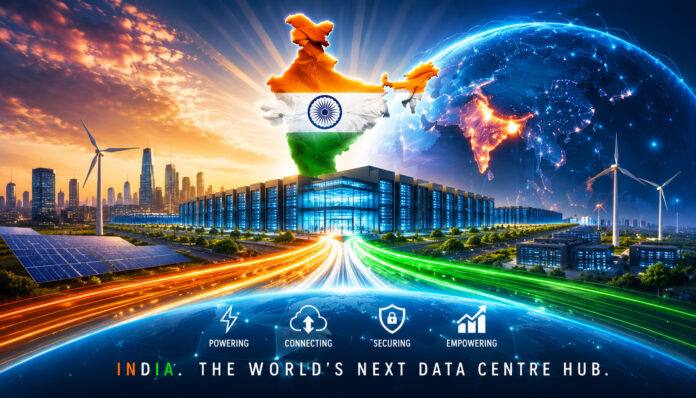
Think about the last time you paid for something with UPI, sat through an online lecture, checked crop prices on your phone, or booked a train ticket. None of that just magically happens in the cloud. It all runs through data centres, those big, carefully cooled buildings packed with servers that store, process, and move our digital lives at lightning speed. You don’t notice them on your daily commute, but they’re the quiet engines powering modern India. What’s striking is how quickly this engine is ramping up. Back in 2020, India’s total data centre capacity was a relatively modest 0.5 gigawatts. By 2025, it had nearly tripled to around 1.5 gigawatts.
Looking ahead to 2030, experts expect it to reach somewhere between 6.5 and 10 gigawatts. The money follows the growth; between 2019 and 2025 alone, nearly $95 billion was committed to the sector. That’s not marketing talk, that’s serious capital betting on India’s digital future.
This boom didn’t appear out of thin air. The government has deliberately treated data centres the same way it treats roads, railways, and power plants, as critical infrastructure. Policies now offer tax breaks, faster approvals, and easier access to land. States have joined the competition, offering cheaper electricity, land incentives, and single-window clearances to attract projects. The result is a genuine race to the top rather than a race to the bottom. The human impact shows up most clearly in jobs and opportunity. Every large data centre needs engineers, cybersecurity specialists, network administrators, and facility managers. By 2030, the sector could create more than one lakh direct jobs, plus many more indirect roles in construction, power, water, and support services. These facilities are also the backbone of India’s digital economy, which the government expects to contribute an extra $1 trillion to GDP by 2030.
There’s a security dimension too. When bank details, health records, and government data stay inside India, they remain under Indian law instead of foreign rules or surveillance regimes. As the United States and China compete for tech dominance, India is positioning itself as a stable, democratic third option for global companies looking for a reliable place to host their data. Of course, the rapid growth raises legitimate questions about water and electricity use. Operators are already responding by shifting to recycled water, more efficient cooling systems, and greater use of renewable energy.
The map is expanding beyond the usual hubs. Mumbai and Chennai are no longer the only names in the conversation; Hyderabad, Visakhapatnam, and other cities are joining the list, helping spread digital infrastructure and opportunity more widely across the country.
The full article is available in Chapter One Mag.


