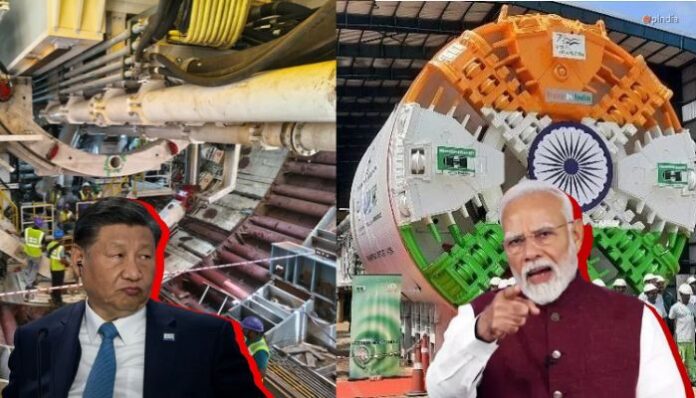
Months after semiconductor export curbs, China has announced export controls on tunnel boring machines (TBMs) and related equipment. China’s Commerce Ministry said the TBM export curbs announced on 19th October will come into effect from 18th November 2026.
The new controls require exporters to obtain licenses under the provisions of export control law and regulations on the export control of dual-use items, citing national security and the civilian-military potential of TBMs.
“However, there could be issues with the import of high-duty engines that go into this equipment, high mass cranes and tunnel boring equipment which could impact some critical projects, including the Bullet Train project,” a Chinese official said.
The control measures introduced by China also cover walking excavators, plateau-type wet shotcrete machines, and specific dredger components.
China is reported to have notified countries through export-control dialogues.
China’s new export controls on tunnel boring machines (TBMs) not only formalise leverage over shipments but also create hurdles for development projects in India
While China claims that applications meeting requirements under the new license policy will be approved and that it wants stable supply chains, it is a strategic move rooted in economic coercion that will affect India.
Before the 18th of November license requirement and dual-use classification move, China had, in 2024, started delaying customs clearances for shipments of tunnel boring machines to India. In August 2025, China eased curbs for India. However, Beijing has once again tightened export rules under the pretext of ‘security concerns’.
This is a matter of serious concern for India. India is one of the world’s largest markets for tunnel boring machines, with some reports describing it as the second-largest TBM market. India uses TBMs extensively for metro networks, rail corridors, road tunnels, and strategic projects near borders.
China is a dominant global TBM producer, with various estimates suggest that 70% of the global TBM output originates from China, and a key node even for non-Chinese companies.
Several machines branded as German, particularly Herrenknecht, or others have been assembled in Chinese plants.
After the Galwan clashes, China-India relations remained tense until recently. The bilateral tensions led to prolonged delays in India-bound shipments. It was reported earlier that Herrenknecht machines manufactured in China for Indian projects faced months-long delays or longer holds, warranting high-level diplomatic engagement before clearance.
Even after direct Chinese exports have plunged, the China-based manufacturing footprint generates residual vulnerability for parts and full machines.
India’s imports of self-propelled TBMs rose significantly in 2021 and 2022, with the majority coming from outside of China. However, India was nearly entirely dependent on China in 2019 in terms of both value and volume of standard TBMs.
Notably, imports of tunnelling machinery from China have slumped further in subsequent years, dropping from $18 million in 2022-23 to $3 million in 2023-24. The figures further declined from $500,000 in 2024-25 before edging up to $800,000 in 2025-26. While these figures do not measure the full scale of delays to infrastructure projects, they do capture the disruption in trade.
Although most self-propelled TBMs have been imported from non-China sources in recent years, India remains import-dependent for large-diameter machines and critical components.
Industry experts estimate the Indian market size in thousands of crores annually, with a multi-lakh crore tunnelling project planned.
Why TBMs matter
India is a rapidly developing country. Thus, demand for tunnel construction has also surged significantly across sub-sectors, particularly hydro power, railways, roads and highways, water supply, and metro.
With growing urban agglomerations and land availability becoming scarce, tunnel construction is emerging as a key solution. Experts and various studies suggest that this trend is likely to continue in the coming years.
For tunnel construction, there are two kinds of techniques: conventional and modern. Among conventional ones are the drill-and-blast method (DBM), the New Austrian Tunnelling Method (NATM), tunnel boring machines (TBMs) and micro-tunnelling.
Among modern techniques, the most frequently used are sequential excavation and ground freezing.
However, given that TBMs are more suitable for congested urban areas and reduce lining costs, TBMs are likely to remain as the preferred mode for hard rocks or geological conditions with lower variability.
What the Modi government is doing to reduce import dependence for tunnel boring machines
Curbing TBM imports is paramount not only due to vulnerability to procurement delays due to lengthy procurement processes, customs clearance, and logistical issues, but also because importing advanced tunnelling equipment incurs substantial costs, including import duty and shipping and handling fees. These issues inflict both delayed project completions and cost burdens.
The Central government has publicly acknowledged these vulnerabilities and demonstrated in both rhetoric and action, its seriousness about reducing import dependence for TBMs.
It must be recalled that in October 2024, Commerce Minister Piyush Goyal had raised the issue of China’s TBM export-blocking manoeuvres with the visiting German Vice Chancellor Robert Habeck.
More recently, the Modi government in the Centre is reported to be advancing a PLI-style incentive scheme worth $1.2 billion for domestic manufacture of TBMs and high-value infrastructure equipment.
Meanwhile, India has already started domestic production of TBMs.
In a major step towards curbing import dependence, the State-owned BEML or Bharat Earth Movers Limited, announced plans to design and manufacture TBMs indigenously. It floated expressions of interest for design partners, including those from Japan and Austria, targeting a range from around 6 m to 16.5 m diameter, beginning with a 6.5 m prototype. The BEML has received the backing of defence and housing/urban affairs ministries under Atmanirbhar Bharat.
Notably, TBMs manufactured in India feature a massive cutterhead with a diameter of 13.6 meters (equivalent to the height of a 4-story building), weighs 3,200 tonnes (equivalent to 500 Asian elephants), and has a total length of 96 meters (comparable to the length of a 105-meter football pitch).
The machine comprises several key components, including the cutter wheel/head, main bearing, jaw crusher, erector, main shield, tail shield, and four specialised gantries that support tunnelling operations.
In early July 2026, India’s first TBM commenced tunnelling from the Vikhroli shaft towards the under-construction Mumbai Bullet Train station for the Mumbai–Ahmedabad Bullet Train Project.
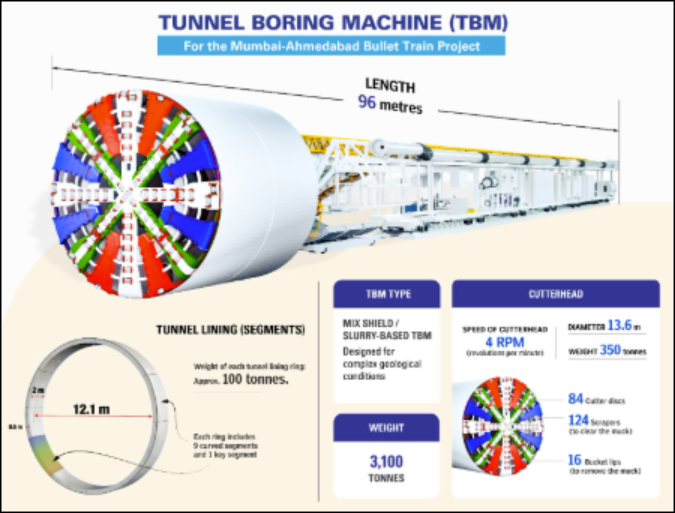
The machine used for the Mumbai–Ahmedabad Bullet Train Project is a Mixshield TBM, an advanced slurry-type tunnelling system specially designed for large-diameter tunnel excavation in mixed ground and high groundwater pressure conditions.
In mid-July 2026, India’s second TBM began tunnelling from Sawli (Ghansoli) towards Vikhroli in Maharashtra for the Mumbai–Ahmedabad Bullet Train Project.
In the next seven years, India is expected to attract over $1.8 billion in investment.
In addition to incentivising indigenous designing and manufacturing of TBMs, India has also pushed foreign localisation.
Germany’s Herrenknecht, which has had an assembly presence in Chennai since 2007, has manufactured or refurbished dozens of machines, including metro-sized units, and is aiming for 60-70% local content on components.
Germany’s Herrenknecht AG plans to Make in India – now aiming to manufacture larger-size Tunnel Boring Machines in addition to their existing lineup. https://t.co/YlkCl6oBUd
— Ashwini Vaishnaw (@AshwiniVaishnaw) May 28, 2025
Herrenknecht also has expansion plans, with a new 12.4-acre plant to increase capacity and handle larger diameters.
It is interesting to note that this shift was accelerated by earlier China export difficulties. As the incentive framework and demand materialise, other private players, including L&T, could also participate in domestic TBM production.
Moreover, reports say that stakeholder consultations are underway to mitigate the Chinese export curbs, noting that even though there may not be immediate large-scale disruption, issues can arise for engines, high-mass cranes, and, most importantly, tunnelling equipment on critical projects.
Undoubtedly, full indigenous production of massive, complex TBMs is still confined to nascent stages, China’s fresh TBM export curbs can turn out to be a blessing in disguise, if the Central government and industry stakeholders push toward pure Indian TBM design and production while also accelerate localisation for foreign players.