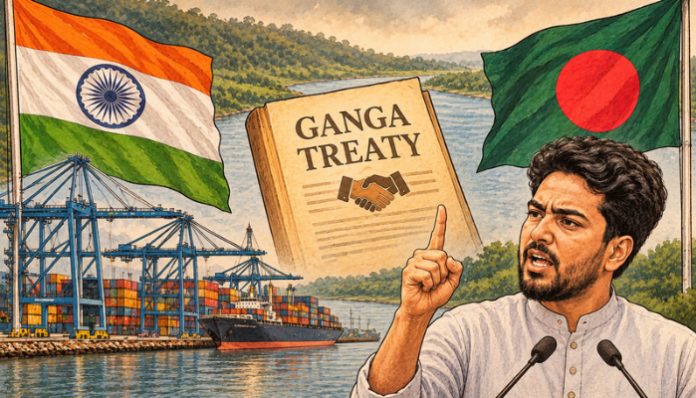
With barely a month left before the 30-year Ganga Water Treaty expires on 12 December, the prospect of an automatic renewal is fading fast. New Delhi has signalled that it is unlikely to roll over the agreement without a visit by Bangladeshi Prime Minister Tarique Rahman. Meanwhile, Bihar is actively opposing the straightforward renewal.
This diplomatic vacuum has become infused with a volatile cocktail of opposition politics, economic grievances, and Islamist mobilisation in Bangladesh. It turned water-sharing and a Japan-funded port project into weapons of mass political distraction. The result is an intense resurgence of anti-India rhetoric in Bangladesh, led by Jihadi Nahid Islam’s National Citizen Party (NCP) and backed by the terror outfit Jamaat-e-Islami, which threatens to poison bilateral relations for years to come.
Why renewal is in doubt: Delhi’s reluctance
The first indication that the renewal of the treaty would not be a mere formality came from the Indian side. According to reports, New Delhi is not prepared to automatically extend the 1996 agreement. The condition for this is that Bangladesh’s Prime Minister, Tarique Rahman, must visit India for a summit-level meeting, much like the arrangement in place when the treaty was first signed under a prime ministerial-level framework.
Rahman has visited China, Japan, Malaysia, and the United States since taking office, but has so far declined to make the short trip to New Delhi. Without that political engagement, Indian officials have made clear that the “structured mechanism” of the Joint Rivers Commission is not a substitute for a formal renewal decision.
Domestic pressure within India has hardened this position. Bihar Chief Minister Samrat Chowdhury has publicly stated that the state’s interests must be protected before the treaty is renewed. It cites rising demand for freshwater, industrial requirements, and the needs of thermal power plants. Bihar’s concerns centre on sedimentation around the Farakka Barrage and the impact on water flow in adjoining areas, and its objections have been echoed by other stakeholders who want a broader river-basin approach rather than a simple extension of the 1996 terms.
On the other side, the BNP government in Dhaka is seeking a more favourable arrangement. They specifically want the restoration of the “minimum guarantee” clause from the 1977 accord, which ensured Bangladesh received at least 80 per cent of its scheduled allocation during the lean season. These competing demands have made a clean renewal increasingly difficult, and the uncertainty has become the oxygen for a wider political fire.
The Ganga treaty: A deadline looms
The 1996 treaty governs the sharing of Ganges water at the Farakka Barrage during the dry season, spanning from January 1 to May 10. According to the treaty formula, when the flow drops to 70,000 cusecs or less, both countries will share the water equally. The agreement guarantees that each country will receive 35,000 cusecs. Between 11 March and 10 May, each nation will get 35000 cusecs of water in three alternating ten-day periods.
For Bangladesh, the treaty is more than just a technical document. It is a lifeline for its agriculture, river navigation, and the ecological health of the delta. For India, it is a balancing act between the needs of Bihar, West Bengal, and the Kolkata port, all of which have legitimate claims on the river’s flow.
Therefore, the expiry of this treaty became a political flashpoint in Bangladesh. The BNP-led Bangladeshi government has indicated that it wants to pursue negotiations rather than abandon the treaty. On 2 November, Bangladeshi state minister of foreign affairs, Shama Obaed, said Dhaka remained hopeful of renewing the agreement. She said Rahman had formed a committee to prepare for negotiations and that discussions were taking place at different working levels.
Matarbari Port: Connectivity vision becomes an anti-India target
If the Ganga Treaty provides the emotive raw material, the Malabari deep-sea port provides the geopolitical conspiracy narrative. On 26 October, the Bangladeshi Prime Minister Rahman visited Tokyo. Japan and Bangladesh agreed to upgrade the Bay of Bengal Industrial Growth Belt (BIG-B) into a broader framework called “BIG-B for Shared Prosperity.
The Matarbari port in Cox’s Bazar district sits at the centre of this initiative. Separately, in 2023, a Japanese plan was announced: ‘the Bay of Bengal–Northeast India Industrial Value Chain Initiative’. It envisions connecting India’s seven northeastern states to the Bay of Bengal via Bangladesh, potentially allowing Indian goods to reach Matarbari by passing through Bangladeshi territory.
Dhaka has denied that the expanded BIG-B framework involves any third country. But the separate connectivity proposal has given opposition parties fresh ammunition to question the government’s dealings in regard to India.
At the 30 October rally in Dhaka, anti-India jihadist student leader Nahid Islam accused the Tarique Rahman government of failing to protect Bangladeshi interests from alleged Indian conspiracies. According to him, the Bangladeshi PM had attempted to give India what he called an illegal corridor during the Japan visit.
While sharing the stage, terrorist outfit Jamaat-e-Islami’s Chief Shafiqur Rahman also questioned the Bangladeshi government’s position on Matarbari. Spewing anti-India hate, he said, “The country could not be leased out in the name of connectivity”.
In other words, the port has been transformed from an infrastructure project into proof of a supposed Indian design to use Bangladesh as a transit route for its northeastern states. A claim that resonates deeply in a broken country where sovereignty is a potent political currency.
Nahid Islam and the NCP’s anti-India offensive
The National Citizen Party (NCP) was formed by anti-India Islamist Nahid Islam and Akhar Hossain, who led the anarchy against Sheikh Hasina in 2024. It has emerged as the most vocal vehicle for this anti-India rhetoric. They allied with the terror outfit Jamaat-e-Islami to contest the February elections against the BNP. The NCP now leads the primary opposition alliance, and it has seized on both the Ganga Treaty and the Matarbari port to attack the government from a nationalist and Islamist-charged platform.
At the 30 October rally, protesters chanted “Dilli na Dhaka? Dhaka, Dhaka!”, a slogan designed to cast the BNP government as subservient to New Delhi. Nahid Islam accused India of conspiring against Bangladesh. He raised allegations of killings along the border and made false claims that Muslims in Assam and West Bengal were being persecuted. These fake allegations serve a purpose: to frame India as an existential threat to Bangladeshi sovereignty and to Islam.
No water, no transit. If India denies our rivers their rightful flow, Indian goods will not flow through Bangladesh. There will be no corridors and no transit facilities. We carry the legacy of Maulana Bhashani’s historic Farakka Long March. Our sovereignty and water rights are non-negotiable. If necessary, we will march to Farakka once again.
— Nahid Islam (@NahidIslam_24) November 1, 2026
On 1 November, in an X post, Nahid doubled down with an empty threat: “No water, no transit.” He declared that if Bangladesh did not receive its fair share of Ganga water, Indian goods would not be allowed to enter Bangladesh and there would be “no corridors, no transit”. He further said, ” We carry the legacy of Maulana Bhashani’s historic Farakka Long March. Our sovereignty and water rights are non-negotiable. If necessary, we will march to Farakka once again”.
Crucially, Nahid also demanded full transparency regarding agreements with Japan concerning Matarbari and insisted that no international treaty be ratified without parliamentary debate. He warned that any attempt to grant unlawful transit or corridor access to India would face strong public resistance.
In his false framing, the port is not a development opportunity but a secret deal to sell Bangladeshi territory to Indian interests. He tries to build an anti-India narrative by merging economic nationalism with anti-Hindu hate and Islamic suspicion.
The Broader Anti-India ecosystem in Bangladesh
The NCP is not acting in isolation. Terror outfit Jamaat-e-Islami’s presence at the rally and its chief Shafiqur Rahman’s remarks on Matarbari say a lot. It signals a broader convergence of Islamist and nationalist forces around the anti-India theme. The BNP government itself is not immune to this pressure; while it seeks negotiations on the Ganga Treaty, it must contend with an opposition that is happy to portray any compromise as a betrayal.
The anti-India chorus is further amplified by economic distress: garment worker protests over wages, high inflation, and an energy crisis have created a volatile backdrop in which foreign conspiracy theories find receptive audiences. Some politicians and police officials have even blamed India for the garment unrest, adding another layer to the anti-India narrative.
Sheikh Hasina’s return and the political calendar
The timing is especially delicate because former Prime Minister Sheikh Hasina has announced her intention to return to Bangladesh in December. She has been living in India since her ouster in August 2024. Her presence in India has long been a grievance for the BNP and its allies, and her planned return is likely to intensify political temperatures.
The anti-India rhetoric serves multiple purposes: it distracts from the government’s economic failures, it mobilises the NCP’s base ahead of possible future elections, and it puts pressure on the BNP to adopt a harder line on water and connectivity. The risk is that rage-baiting politics will make it politically impossible for Dhaka to negotiate a sensible renewal of the Ganga Treaty, even if a deal’s technical contours are within reach.
Conclusion
The Ganga Water Treaty is too important to be held hostage to domestic political theatre. A failure to renew it would harm Bangladesh’s farmers, fishermen, and riverine ecosystems far more than it would hurt India. It would poison the broader relationship for years.
Similarly, the Matarbari port, a Japanese-funded project that could bring jobs and infrastructure to one of Bangladesh’s poorest regions, should not be reduced to a caricature of an “Indian corridor” for the sake of rally applause. Yet the incentives for the NCP and its allies are clear: anti-India rhetoric works, especially when it is fused with water, sovereignty, and religion.
India’s reluctance to renew the treaty without a prime-ministerial visit, and Bihar’s insistence that its own water needs be addressed, are legitimate positions that require diplomatic engagement, not demonisation.
The Bangladeshi government has a limited window of opportunity to separate the core negotiations from unnecessary noise and reassure the public that transparency does not equate to capitulation. They should prevent the issues surrounding the Ganges and Matarbari from becoming a permanent fixture in the ‘politics of grievance’ in Bangladesh.
If it fails, the December deadline will not just mark the expiry of a water treaty; it will mark the beginning of a new era of distrust between two neighbours in which Bangladesh cannot afford to be an enemy of India.