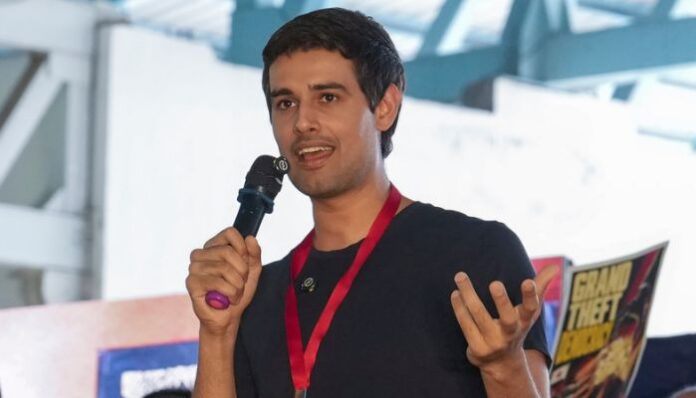
On Monday, 23rd November, a Delhi court issued a non-bailable warrant (NBW) against anti-India YouTuber Dhruv Rathee in a 2018 criminal defamation case filed by social media influencer Vikas Sankrityayan, popularly known as Vikas Pandey. The case relates to a series of videos in which Rathee had accused Pandey of being involved in an alleged attempt to bribe a former BJP IT Cell member to make statements against him.
A Delhi Court has issued a non-bailable warrant (NBW) against YouTuber Dhruv Rathee in the 2018 defamation case https://t.co/70WoOndR1p
— OpIndia.com (@OpIndia_com) November 23, 2026
The warrant was issued by Judicial Magistrate First Class (JMFC) Anam Rais Khan at the Saket Court. The matter has been listed for further proceedings on 3rd December, 2026. A detailed order is awaited.
#Breaking Delhi court issues non-bailable warrant (NBW) against Youtuber Dhruv Rathee in 2018 defamation case filed by Vikas Sankrityayan alias Vikas Pandey. @dhruv_rathee @MODIfiedVikas https://t.co/mYibqpv92A
— Bar and Bench (@barandbench) November 23, 2026
The development comes after the court had issued bailable warrants against Rathee in October after attempts to serve him notice failed. When the notice was served to the AAP propagandist, it was found that the premises of his residence were locked. The court had also issued fresh summons at his Gurugram address.
Pandey had earlier approached the court seeking an early hearing, pointing out that Rathee (who ordinarily resides in Germany) was in India in connection with the Cockroach Janta Party (CJP) protest. His counsel, advocate Samaksh Sharma, had argued that the service of summons had been delayed for several years because Rathee primarily lived outside India. The non-bailable warrant issued against Rathee authorises the police to arrest him and produce him before the court.
Pandey also confirmed the latest development on X, writing, “Non-bailable warrant issued against Dhruv Rathee.” In a separate post, he thanked his advocate, Samaksh Sharma, for pursuing the matter.
Non-Bailable Warrant issued against @dhruv_rathee ✌️
— Vikas Pandey (Sankrityayan) (@MODIfiedVikas) November 23, 2026
What is a non-bailable warrant and why does a court issue one?
A non-bailable warrant is a court-issued order directing the police to arrest a person and produce them before the court. It is generally used when the court considers an arrest necessary to secure an individual’s presence in judicial proceedings, particularly when earlier measures such as summons or bailable warrants have not worked.
Unlike a bailable warrant, an NBW does not carry an endorsement allowing the police to release the arrested person on a bail bond. Courts may consider issuing an NBW when a person repeatedly fails to appear despite being summoned, appears to be deliberately avoiding proceedings, or is considered likely to evade the legal process. However, such warrants are not supposed to be issued mechanically or as a routine measure.
In a 2007 judgment, the Supreme Court laid down that courts should generally follow a graduated process in complaint cases: first issue summons, then a bailable warrant if necessary, and resort to a non-bailable warrant if there is sufficient reason to believe that the accused is intentionally avoiding the proceedings.
What does the non-bailable warrant mean in Dhruv Rathee’s case? Can he be arrested?
The non-bailable warrant issued against Dhruv Rathee authorises the police to arrest him and produce him before the court. It follows the earlier issuance of bailable warrants and unsuccessful attempts to serve him with court notices. The complainant had also highlighted Rathee’s presence in India during the CJP protests while seeking an early hearing and fresh steps to secure his appearance.
Under Section 79 of the Bharatiya Nagarik Suraksha Sanhita (BNSS), 2023, an arrest warrant can be executed anywhere in India. If Rathee is located within the country, the police can execute the warrant, arrest him and take him into custody. If the warrant is to be executed outside the jurisdiction of the Saket Court, Sections 80 and 81 of the BNSS provide for the warrant to be forwarded or endorsed through the police or the concerned authorities in that area.
The officer executing the warrant must inform the person of its substance and show it if required. Under Section 78, the arrested person must be produced before the court without unnecessary delay and, in any case, within 24 hours, excluding the time required for the journey.
Since the warrant is non-bailable, the police cannot release Rathee on a bail bond on the spot; he would have to seek bail from the competent court.
Defamation case against Dhruv Rathee
The case dates back to 2018, when Rathee published a three-part video series making allegations against Vikas Sankrityayan, also known as Vikas Pandey. In the videos, Rathee claimed that Pandey was associated with the BJP IT Cell and had allegedly offered ₹50 lakh to a person named Mahaveer Prasad, who claimed to be a former member of the BJP IT Cell, to make statements against Rathee.
Friends, I have initiated Civil defamation suite against Mr. @dhruv_rathee. Hon. Court has taken cognisance of my suite. He had made false claims against me in a popular video saying I offered bribes of huge amount to someone without ANY proof. Read:https://t.co/9m7f0n1ujz [1/3]
— Vikas Pandey (Sankrityayan) (@MODIfiedVikas) October 1, 2018
After the three-part video series was released, Vikas Pandey filed a defamation case against him, claiming ₹15 lakh. Rathee had claimed that Mahaveer Prasad had a recording of the call where Pandey allegedly bribed him to talk against Rathee. But after Pandey filed a police complaint, Rathee, in a follow-up video, said that he ‘regrets’ that he didn’t have the recording of the ’50 lakh bribe’ offer.
The matter against the anti-India YouTuber Rathee is now listed for 3rd December, following the issuance of the non-bailable warrant.