

Mohammad Deepak, who was arrested for assaulting a shopkeeper, is now playing the victim card, claiming that his Facebook account has been blocked in India. After his release from jail on Friday, September 2, Deepak created another Facebook account and told his followers that his original account had been suspended, saying he could no longer upload videos or photos.
Mohammad Deepak’s Facebook account blocked in India after bail
— Atulkrishan (@iAtulKrishan1) October 3, 2026
After securing bail, Mohammad Deepak created a second Facebook account and informed his followers that his original account had been blocked in India.
He claimed that due to the account being blocked, he is unable… pic.twitter.com/fwSDsuv6VO
In a post on his new account, Deepak said, “Namaskar friends, I am Deepak Kumar, also known as Muhammad Deepak Kumar. You must have been seeing for some time that I am not able to upload any of my videos or photos on social media. The reason for this is that my Facebook account has been banned in India. If these people are thinking that after closing my account, my voice will be suppressed, my voice will be banned, then they have a very big misunderstanding.”
Deepak has presented the account action as an attempt to stop his voice on social media. However, the restriction on his account came after he was booked and arrested following a confrontation with a saree shop owner in Kotdwar, Uttarakhand. His social media account was blocked in connection with the case, after which he created another account to continue posting.
Account can be restricted during a legal case
In India, online content or social media accounts can be restricted through legal and platform procedures in certain circumstances. One of the key legal provisions related to blocking online information is Section 69A of the Information Technology Act, 2000.
Under Section 69A, the Central Government or an officer specially authorised by it can direct a government agency or an intermediary to block public access to information available through a computer resource.
The law allows such directions when the government considers them necessary or appropriate in the interest of the sovereignty and integrity of India, defence of India, security of the State, friendly relations with foreign States or public order. It also covers preventing the incitement of certain cognizable offences connected with these grounds. The reasons for a blocking order have to be recorded in writing.
This means online content can be blocked through a legal process in specific situations. The restriction depends on the circumstances and the applicable legal or platform process.
What happened in the shopkeeper case?
The case against Deepak relates to a confrontation with a saree shop owner in Kotdwar, Uttarakhand. The dispute reportedly started with comments exchanged between the two on Facebook before turning into a face-to-face confrontation.
Deepak later went to the saree shop on Ganga Dutt Joshi Marg in Kotdwar, where a heated argument took place. A video of the incident was subsequently circulated on social media. In the video, Deepak is seen threatening the shopkeeper.
Following the video and a complaint by the trader, Kotdwar police took Deepak into custody. The confrontation resulted in a case being registered against him, and he was arrested in connection with the incident.
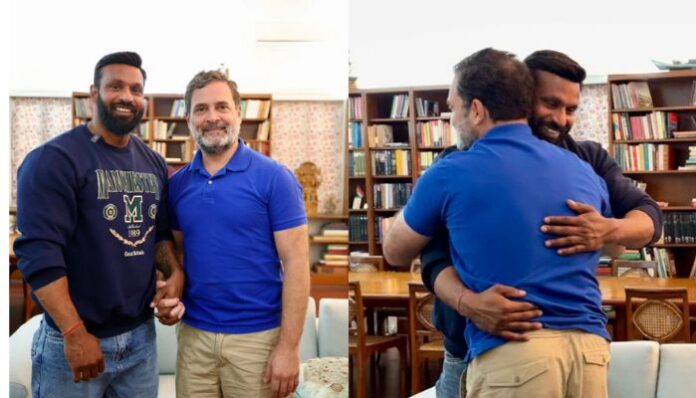
Mohammad Deepak is the hero of Rahul Gandhi
Deepak Kumar, who runs a gym in Kotdwar, first attracted widespread attention on January 26, 2026, following a controversy involving the name of a local shop.
The dispute concerned a shop operated by a Muslim trader, Shoaib Ahmed, under the name “Baba School Dress and Matching Centre.” According to reports, some residents objected to the use of the word “Baba”, citing its religious significance in Kotdwar, where Siddhabali Baba is an important religious and cultural figure. The objection led to a confrontation involving several people.
During the ensuing argument, Deepak reportedly arrived at the spot along with Youth Congress district president Vijay Rawat and others. When someone asked Deepak his name, he responded by calling himself “Mohammad Deepak”, apparently in a sarcastic manner. A video of the incident subsequently went viral, and the unusual name quickly became associated with him online.
Notably, he has a problematic history. OpIndia’s investigation revealed his links to a Dubai-based businessman, Chand Maula Baksh, who regularly organised bodybuilding events for him.
A viral post by Mohammad Deepak called those who describe the terrorists involved in the Pahalgam attack as Muslims “chutti@”. In a comment on the same post, he says that “if the terrorists took off the pants of Hindu men before killing them, then what did they take off the women?”
While Rahul Gandhi has described him as a “Mohabbat Ki Dukaan” warrior, Mohammad Deepak’s history is marred by a one-sided pro-Islamist narrative.
